

The challenge
Using hydrogen as a fuel lowers the CO₂ emissions of industrial heating processes. As a burner manufacturer, we are therefore developing an installation that works, remains affordable, and is safe. For development and testing, we collaborate with energy engineering firm DNV in Groningen, which has extensive testing facilities.
Hydrogen behaves differently than natural gas. The calorific value, density, combustion speed, flame temperature, and the dew point of flue gases differ. Currently, hydrogen has limited availability and is relatively expensive. In the longer term, it can completely replace natural gas.
Safe operation
Because hydrogen is currently still limited in availability and affordability, we started with mixtures of hydrogen and natural gas. We incrementally increased the proportion of hydrogen and phased out natural gas. This resulted in a burner system that works with any composition: 100% natural gas, 100% hydrogen, and all mixtures in between. The burner adjusts automatically and does not need to be set manually.
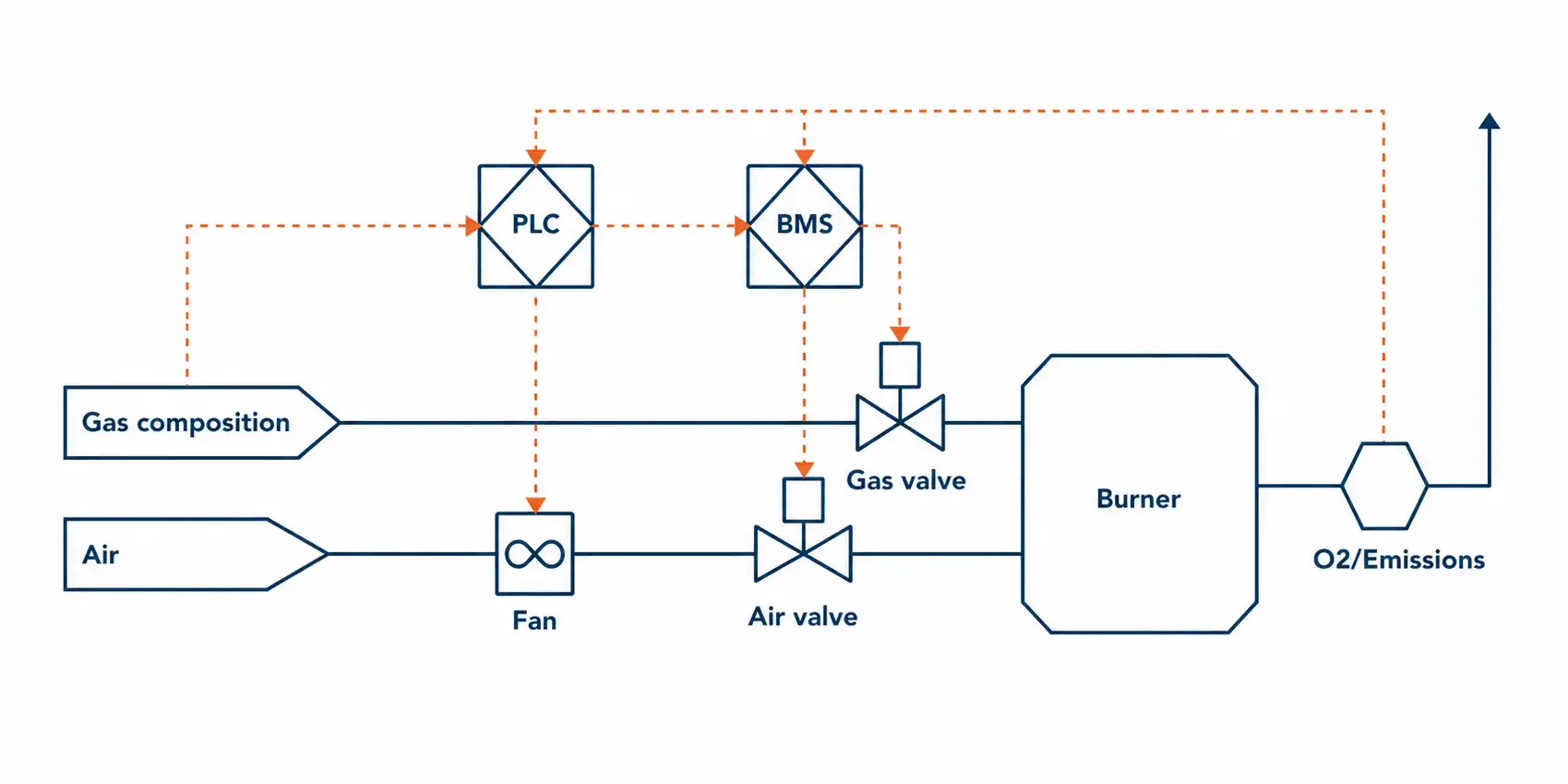
In the test setup, we used a Zantingh forced draft burner on a 475 kW 3-pass central heating boiler. The fuel/air ratio and power are controlled by an internally developed, fuel-adaptive control system, linked to a Siemens burner management system.
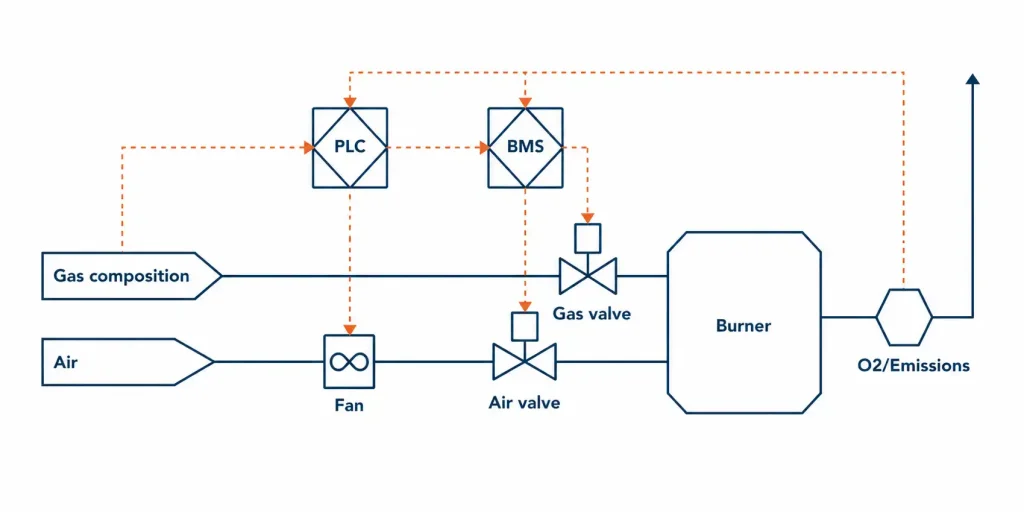
A feedforward control system keeps the oxygen percentage in the flue gases and the heat input constant, regardless of the hydrogen share. A gas quality sensor in the fuel line measures the composition. This data is sent to a PLC, which runs the combustion algorithm. This algorithm continuously calculates the required fuel and air flows for the requested ratio and the desired power.
During the tests, we continuously measured NO, NO₂, CO, CxHy, and oxygen. Even with changes in air demand and Wobbe index, the system remains stable. The oxygen percentage and heat input remain constant.
The flame pattern changes visibly. Natural gas produces a blue flame, while hydrogen produces a more orange flame. With mixtures from 0 to 100% hydrogen, the flame remains stable and the burner surface temperature does not rise noticeably.

Due to the high flame temperature, thermal NOx is produced during hydrogen combustion. Using flue gas recirculation, we bring these emissions below the legal standard.
Affordable
Hydrogen emits no CO₂ during combustion. A major advantage is that existing boilers, furnaces, and installations remain largely usable. You do not have to completely redesign your process. This keeps investments lower than with full electrification.
Electrical solutions can reduce CO₂, but are not always technically or economically feasible. Often, a heavy grid connection is required, which is unavailable due to grid congestion. In some processes, direct interaction between flue gases and the product is necessary. Hydrogen then offers a viable alternative.
Based on the tests, we conclude that this burner system enables the use of hydrogen within the existing gas network. Both during the transition and in the situation where natural gas has been completely replaced.
Background: hydrogen as a fuel
Hydrogen is the lightest and most abundant element. It is colorless, odorless, and flammable. Combustion produces only water vapor. Therefore, it is seen as an energy carrier for making industry more sustainable.
Hydrogen does not occur freely in nature and must be produced, for example via electrolysis of water. If sustainable electricity is used for this, we refer to it as green hydrogen.
Hydrogen can replace natural gas in industrial processes. Transport can largely take place via the existing gas network. Work is underway on infrastructure for production, transport, storage, and import. Storage can take place in salt caverns, among other places. This allows surplus energy from sun and wind to be utilized.
Research by Hydrogen Europe shows that a combination of an electricity grid and a hydrogen grid is cheaper at a European level than expanding the electricity grid alone. For the period 2030–2050, this could save hundreds of billions of euros.
The European Commission expects electricity to cover approximately 50% of energy demand by 2050. To make this possible, the electricity grid must be significantly expanded. Investments in this are considerably higher than investments in hydrogen infrastructure.
The future hydrogen network is expected to grow to more than 50,000 km by 2040. Approximately 60% consists of repurposed gas pipelines. This lowers costs and shortens lead times. Europe will also need to import hydrogen. Some regions have a lot of renewable energy and low demand. Transport can be via pipelines or in the form of hydrogen carriers such as ammonia or methanol. The choice depends on distance, application, and costs. Underground storage of hydrogen is necessary to balance supply and demand. This supports both the hydrogen system and the electricity grid. Investments are currently still lagging, partly due to long lead times and unclear regulations.
Hydrogen makes it possible to lower CO₂ emissions without completely replacing existing industrial processes. This makes it a practical step towards a low-carbon energy system.